Home Recording Studio Desk Setup Under $2,000
A home recording studio desk setup with audio interface, condenser microphone, studio monitors, and acoustic treatment. Built for podcast recording, voiceover, and music. Total cost: $1,870.
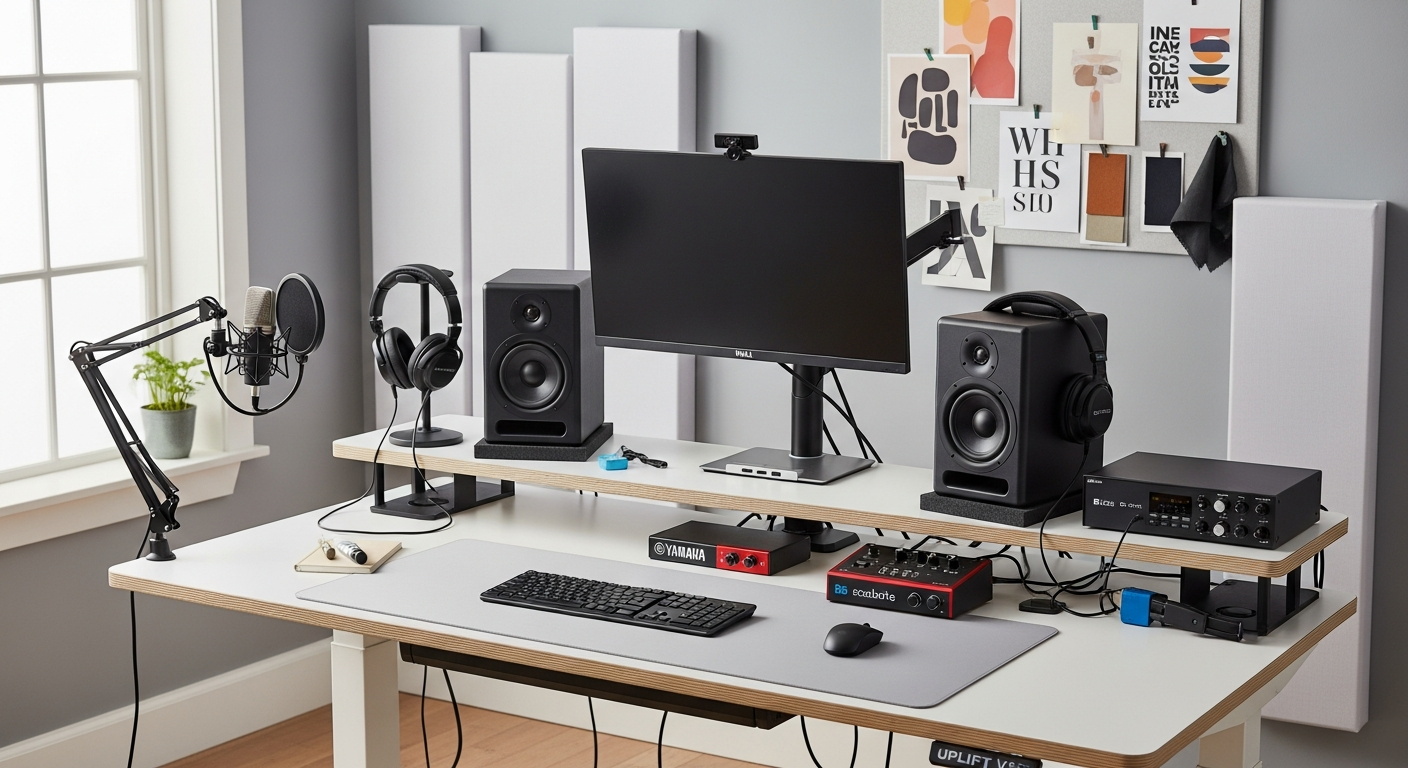
This setup is built around one priority: audio quality at every stage of the signal chain. I spent time getting the interface, mic, monitors, and room treatment working together before worrying about anything else. The desk and monitor came later. The result is a workspace I can record in at any hour without leaving the room.
We may earn a commission if you buy through our links.
Audio Interface and Condenser Microphone
The foundation of this setup is the Focusrite Scarlett Solo Audio Interface paired with the Audio-Technica AT2020 Condenser Mic. The Scarlett Solo costs $119 and provides clean preamp gain with low noise floor. The AT2020 at $99 is an XLR condenser with a cardioid polar pattern and a frequency response that suits spoken voice and acoustic instruments without heavy processing.
The interface converts the analog mic signal to digital and sends it to your DAW over USB. The Scarlett Solo provides 48V phantom power, which the AT2020 requires. Connecting these two is a single XLR cable. I keep a boom arm mounted to the desk edge so the mic sits at mouth height without a stand taking up surface space.
The AT2020 is sensitive. It picks up everything in the room: mouse clicks, chair movement, traffic outside. This is not a flaw. It is a condenser microphone. The solution is acoustic treatment, not a different mic.
For reference listening, I added Sennheiser HD 600 headphones at $349. They have a flat, accurate response curve that reveals mix decisions honestly. The Sony MDR-7506 at $99 stays in the chain for tracking and quick checks. Two headphones serve different purposes: one for critical listening, one for casual monitoring.
Studio Monitors and Isolation
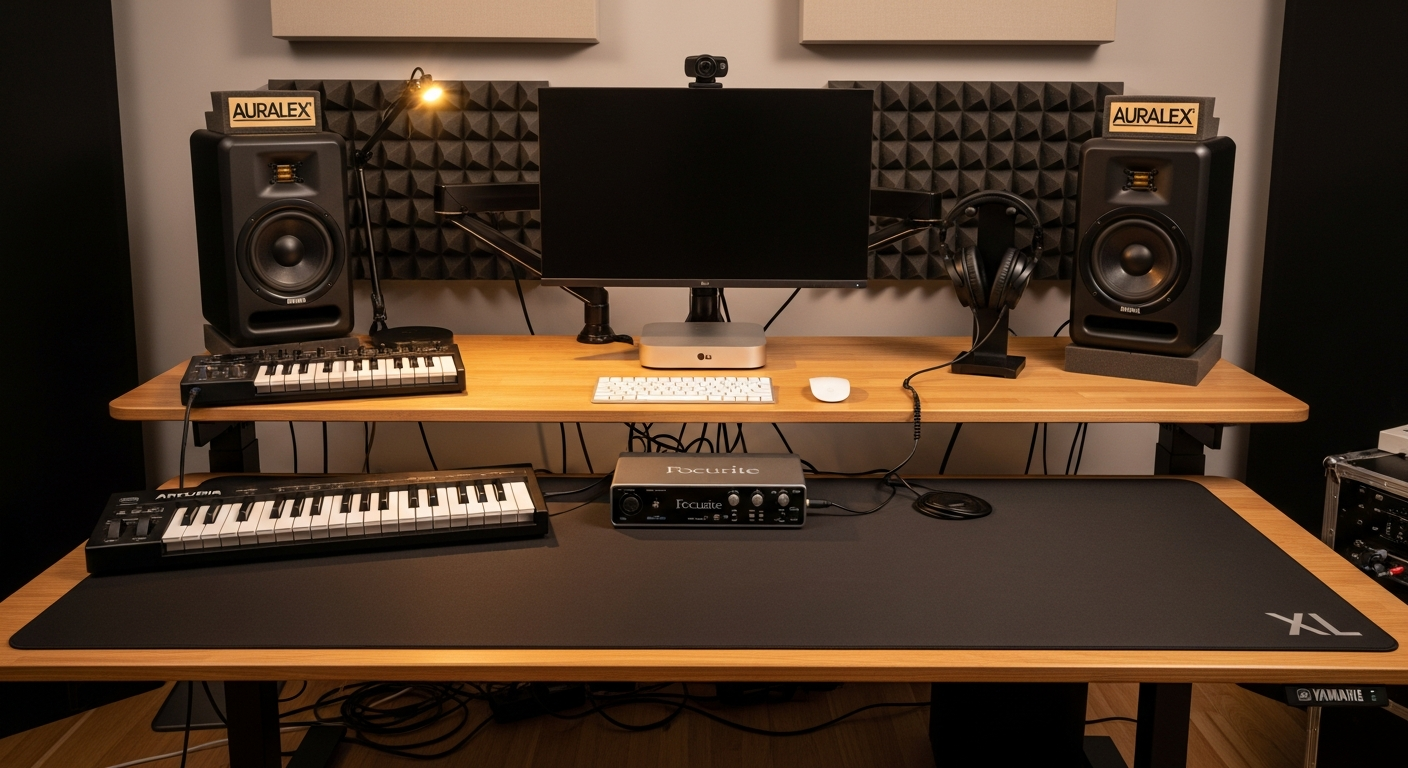
The Yamaha HS5 Studio Monitor Pair at $399 are near-field monitors with a flat response. The HS5 is well known for being honest about mixes. What sounds good on HS5s tends to translate well to other playback systems. I position them in an equilateral triangle with the listening position: each monitor roughly 3 feet from my ears, pointing directly at my head, tweeters at ear level.
The Speaker Isolation Pads at $29 sit under each monitor. Without them, low-frequency energy transfers directly into the desk surface and into the room through the structure. Isolation pads decouple the monitors from the desk. The difference in low-frequency clarity is real. This is a $29 improvement that changes the acoustic behavior of a $399 investment.
I also added a Power Conditioner at $39. Studio monitors are sensitive to electrical noise. A power conditioner filters interference from other devices on the same circuit. Hum and buzz from dirty power disappears.
Acoustic Treatment and Desk Setup
Six of the Acoustic Foam Panels go on the wall behind the monitors. The other six go on the wall behind the listening position. This addresses the two most common reflection problems in a rectangular room: front wall reflections from the monitors and rear wall reflections back toward the listening position. Perfect acoustic treatment requires a professional setup. This treatment is practical and reduces the worst problems for $29.
The UPLIFT V2 Standing Desk at 72 inches gives me enough surface to spread gear out without stacking anything. The Scarlett Solo sits to the left. Monitors flank the display. The AT2020 on its boom arm is positioned in front of the monitor. The 72-inch surface handles all of this with room to spare. I use the standing function during mixing sessions when I need to listen from a different height.
The Dell S3222DGM on a monitor arm gives me the vertical space to position monitors at correct height without the stand eating desk surface. A monitor arm mount was essential here.
What I’d Change
The acoustic treatment is minimal. Twelve foam panels help. They do not replace proper bass trapping or a properly treated room. If I could add to this setup, room corner bass traps would be the first change.
The AT2020 is a strong condenser at its price. I would eventually move to a large-diaphragm condenser like the Rode NT1 for smoother high-frequency response. The AT2020 has a slight presence peak that requires attention on voiced recordings.
I would also replace the under-desk cable tray with a longer model. The audio interface, monitor cables, XLR cables, and power cables all compete for the same routing space. A wider tray would keep things cleaner.
Gear in This Setup
Focusrite Scarlett Solo Audio Interface
$119
Audio-Technica AT2020 Condenser Mic
$99
Yamaha HS5 Studio Monitor Pair
$399
Sony MDR-7506 Studio Headphones
$99
UPLIFT V2 Standing Desk 72-inch
$899
Dell S3222DGM 32-inch Monitor
$329
Boom Arm for Microphone
$59
Acoustic Foam Panels 12-Pack
$29
Speaker Isolation Pads Pair
$29
XLR Cable Set
$19
Headphone Stand
$29
Power Conditioner
$39
Pop Filter
$29
Sennheiser HD 600 Headphones
$349
Cable Velcro Pack
$9
Monitor Arm for Studio Display
$147
USB-C Hub for Mac
$49
Under Desk Cable Tray
$19
Desk Mat for Studio
$38